

It may be months away, but establishing your heat safety program now will ensure you’re prepared when heat season hits. Temperatures continue to climb, with 2025 being the third-warmest year in the National Oceanic and Atmospheric Administration’s (NOAA) global temperature record. Rising temperatures and shifting regulatory landscapes are great reasons to engineer a robust heat safety program for 2026.
Plans that are “reactive” or only rely on traditional methods of evaluating ambient heat and heat stress are no longer a viable strategy. This guide provides a checklist to audit your protocols, evaluate cooling technology, and refine acclimatization schedules before the first heat wave hits.
Getting Ahead of Regulatory Compliance
The Occupational Safety and Health Administration (OSHA) began the process for a rulemaking on heat stress back in 2024. The Proposed Heat Injury and Illness Prevention in Outdoor and Indoor Work Settings Rulemaking has made its way through a public hearing in which concluded on July 2, 2025. Although there are no further updates, implementing the recommendations in the proposed rulemaking would be an asset to heat safety programs.
An Overview of the Proposed Rulemaking:
- Coverage and Jurisdiction: The standard applies to all employers with 10 or more employees in the construction, maritime, agriculture, and general industry sectors.
- Indoor and Outdoor Scope: Protections cover all workers exposed to hazardous heat, including those in outdoor settings and indoor environments with inadequate climate control or heat-generating equipment.
- The 80°F Heat Index Threshold: Once the heat index hits 80°F, employers must provide immediate access to an adequate supply of drinking water and designated, shaded, or climate-controlled break areas.
- The 90°F High Heat Trigger: At a 90°F heat index, active monitoring for heat illness becomes mandatory, along with a requirement for a 15-minute paid rest break every two hours.
- The WBGT Option: Employers are encouraged to use Wet Bulb Globe Temperature (WBGT) for a more comprehensive assessment of environmental heat stress per NIOSH guidelines.
- Designated Heat Safety Coordinator: Every covered employer must appoint a specific coordinator to oversee the daily implementation and compliance of heat safety measures.
- Heat Injury and Illness Prevention Plan (HIIPP): Employers must maintain a written, site-specific HIIPP that includes hazard assessments, control measures, and an annual review process.
- Employee Involvement: Non-managerial employees must be actively involved in the development and execution of the site-specific HIIPP to ensure practical effectiveness.
- New Hire Acclimatization: Employers must implement a gradual heat exposure schedule during a new employee’s first week to allow their body to adapt safely.
- Returning Worker Protocols: Specific reacclimatization steps are required for any employee returning to high-heat work after an absence of 14 days or more.
- General Heat Safety Training: All employees must receive comprehensive training on recognizing heat illness symptoms and understanding their specific role in the safety plan.
- Specialized Supervisor Training: Supervisors must undergo additional training to manage heat-related incidents, monitor high-heat triggers, and oversee emergency response.
Understanding the OSHA National Emphasis Program (NEP)
While the new heat rulemaking provides the framework for compliance, the National Emphasis Program (NEP) on Outdoor and Indoor Heat-Related Hazards is the active enforcement tool OSHA uses to target high-risk workplaces. This NEP became effective in 2022 and has been extended multiple times, currently through April 2026.
Here is what the NEP means for your organization:
- Heat Priority Days: OSHA triggers “Heat Priority Days” whenever the local heat index is expected to reach 80°F or higher. On these days, the agency shifts its focus toward active compliance assistance and inspections in high-risk industries.
- Targeted Industry Inspections: On any day the National Weather Service issues a heat warning or advisory, OSHA conducts pre-planned (programmed) inspections in industries known for high heat exposure, such as construction, agriculture, and manufacturing.
- Mandatory Investigations: Regardless of whether a business is in a “targeted” industry, OSHA will investigate any heat-related fatality, catastrophe, or formal complaint immediately.
- Proactive Outreach: The NEP isn’t just about fines; it includes a heavy focus on compliance assistance. On high-heat days, OSHA field staff are authorized to provide technical help and resources to businesses looking to improve their heat illness prevention plans.
- Focus on Acclimatization: A primary goal of NEP inspections is verifying that employers have functional acclimatization procedures in place for new hires and those returning from extended breaks.
Although the NEP is set to expire in April, there is a possibility it will be extended again, and ensuring your program follows the NEP’s guidelines now guarantees that your organization remains compliant, regardless of how the regulatory clock turns.
The Environment: Moving from Heat Index to WBGT
For many, the “Heat Index” is the default baseline. However, the Heat Index can often underestimate the actual physiological strain on a worker, as it only accounts for how hot it feels in the shade by combining air temperature and humidity.
Wet Bulb Globe Temperature (WBGT) is a more reliable metric when it comes to heat safety. WBGT monitoring is a measure designed to encapsulate the combined effects of air temperature, humidity, wind speed, and visible and infrared radiation on the human body.
Utilizing WBGT as a guide, organizations can tailor their operations to mitigate heat risks. This includes scheduling work during cooler parts of the day, designing work-rest cycles that allow for adequate recovery, and ensuring access to cooling areas and sufficient hydration.
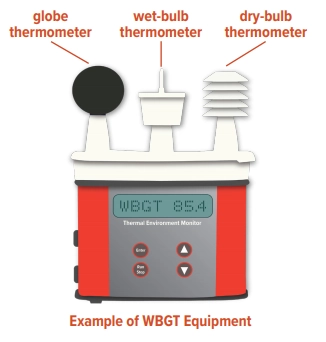
Breaking Down the WBGT Components
| Metric | What it Measures | Why it Matters for Your Site |
| Natural Wet Bulb | Evaporative cooling capacity | Critical for high-humidity environments where sweat cannot evaporate. |
| Black Globe | Radiant heat | Essential for monitoring heat “thrown” by blast furnaces, steam pipes, or forges. |
| Dry Bulb | Ambient air temperature | The baseline for the general environment. |
Digital Resources for the Field:
Monitoring doesn’t always require a permanent infrastructure. Several vetted digital tools can help safety officers audit conditions and stay aligned with federal recommendations:
- OSHA-NIOSH Heat Safety Tool: A reliable app for calculating heat index and viewing hourly forecasts with specific safety recommendations.
- AIHA Heat Stress Mobile App: Based on the ACGIH TLVs, this is an excellent tool for industrial hygienists needing to evaluate heat stress on a more technical, individual basis.
Tech & Innovative PPE
Building a resilient program requires moving from passive protection to active physiological support. Looking into technological solutions to automate and support your current safety program can help with efficiency, prevention, and record-keeping.
PPE: Getting Workers Cooled Off Quickly

Cooling garments or other technology offer a way to help workers cool down faster than just standing in the shade on a hot day. Equipment such as cooling vests could be helpful, but standard ice-pack vests (32°F) can be counterproductive due to vasoconstriction. Extreme cold causes blood vessels to narrow, trapping heat in the core rather than allowing it to dissipate at the skin’s surface.
When looking into cooling vests, Phase Change Materials (PCM) are the industrial standard. These vests maintain a constant temperature, above freezing but low enough to have a cooling effect (anywhere between 55-65 degrees Fahrenheit). This is cool enough to draw heat away without triggering vasoconstriction, supporting the body’s natural thermoregulation.
Palm cooling devices are another option to consider. These innovations help bring core temperature down through either the palms of soles of the feet. It also helps with normalizing heart rates more quickly after exertion, according to an article on wired.com.
Tech: Physiological Monitoring

Wearables have become increasingly more common to keep workers safe. Wearables are used to identify physiological markers of individuals rather than the attributes of the ambient environment. This gives insight into exertion levels, core temperature, heart rate, etc., and can help prevent incidents before they happen by triggering alerts when set thresholds are passed.
Features of real-time physiological monitoring:
- The ability to monitor heart rate and core temperature to identify “high-exertion outliers” before they reach a critical state.
- Set customizable thresholds based on organizational or industry standards
- Collect data to create informed work-rest cycles
- Historical record keeping to review data and the progress of your heat safety program
The Off-Season Pilot
If considering incorporating new technology into your heat safety program, it’s important to not only get buy-in from your workforce but to have time for successful implementation of new tools. This can look like an off-season pilot program with a small group.
This method helps to:
- Ensure Compatibility: Verify fit with existing PPE (harnesses, respirators).
- Establish Baselines: Determine site-specific “normal” ranges for high-exertion tasks.
- Secure Buy-In: Allow workers to vet the gear’s comfort and utility during lower-stakes shifts.
The Acclimatization Audit: Managing the “New Hire” Risk
Acclimatization is more than a policy; it is a physiological “software update.” It is the biological process where the body increases its sweat rate and stabilizes its heart rate in response to heat.
Heat acclimatization refers to beneficial biological adaptations that help reduce physiological heat strain (the overall physiological response resulting from heat stress) in hot environments.
Benefits for heat acclimatization include:
- Decreased heat strain on the heart, brain and other vital organs
- Improved sweating (quicker onset, higher volume) to more quickly cool the body
- Increased worker comfort during physical tasks in the heat
The off-season is the time to audit whether your theoretical protocol matches your field reality. Statistics consistently show that a significant portion of heat-related fatalities occur within a worker’s first few days on the job. To mitigate this “New Hire Risk,” your program must be rigid:
- The 20% Rule: For workers new to the environment, ensure a 20% per day ramp-up in heat exposure.
- The “Rule of Three”: Pay closest attention during the first three days of a heat wave or a new assignment. This is when the cardiovascular system is under the most stress.
- The Paper Trail: OSHA and insurance carriers don’t just want to know you have a plan; they want proof it was followed. Use the off-season to digitize your acclimatization logs so you have a defensible, verifiable record of worker progression before the first spike in temperature.
Conclusion: Preparation is the Only Protection
Heat safety is not just a seasonal task; it is a year-round commitment to reviewing and optimizing heat safety programs to improve outcomes. By being up to date on regulatory standards, necessary tools for measurement, innovative PPE and technology and ensuring your workforce is educated and can be properly acclimatized, you ensure that your site is ready before the 2026 season begins.
2026 Heat Safety Quick-Start Checklist:
- Review & Research Regulatory Trends: Get up to speed on the latest OSHA rulemaking and the 2026 National Emphasis Program (NEP). Understanding the shift toward mandatory 80°F and 90°F triggers now will prevent a scramble when the season hits.
- Proactive Program Architecture: Prepare your written Heat Injury and Illness Prevention Plan (HIIPP) as if the new regulations are already in effect. Getting ahead of the curve ensures that your site is a leader in compliance rather than a follower.
- Master the Environmental Data: Move beyond the heat index. Ensure your team is familiar with Wet Bulb Globe Temperature (WBGT) and how it accounts for radiant heat and humidity, critical metrics for high-risk industrial zones.
- Refine Acclimatization Protocols: Audit your “New Hire” and “Returning Worker” schedules to ensure the 20% per day ramp-up is strictly followed.
- Prioritize Workforce & Leadership Education: Safety is a shared responsibility. Use the off-season to train workers on recognizing early symptoms of heat strain and empower safety leaders to manage high-heat triggers with data-backed confidence.
- Pilot Innovative PPE & Tech: Use the off-season to research and field-test next-gen solutions like PCM cooling vests, palm cooling, and wearable biometrics. A small-scale pilot now ensures a seamless, high-buy-in rollout when temperatures spike.
- Formalize Record-Keeping: Establish a dependable, organized format for logging acclimatization progress, training sessions, and environmental data. Whether digital or manual, ensure your “paper trail” is audit-ready and easy to maintain during the busy season.